
UGC creator multiple revenue streams: stack your income
Beyond brand video deals — how full-time UGC creators build multiple revenue streams with licensing, coaching, templates, and platform funds. Cut income volatility.

One bad month as a full-time UGC creator can feel like the whole business is collapsing. A brand goes quiet after three months of consistent work. Another campaign gets pushed to next quarter. You're staring at a pipeline that looked full two weeks ago and now has nothing confirmed past Friday.
That's not a failure of talent. That's a failure of income architecture.
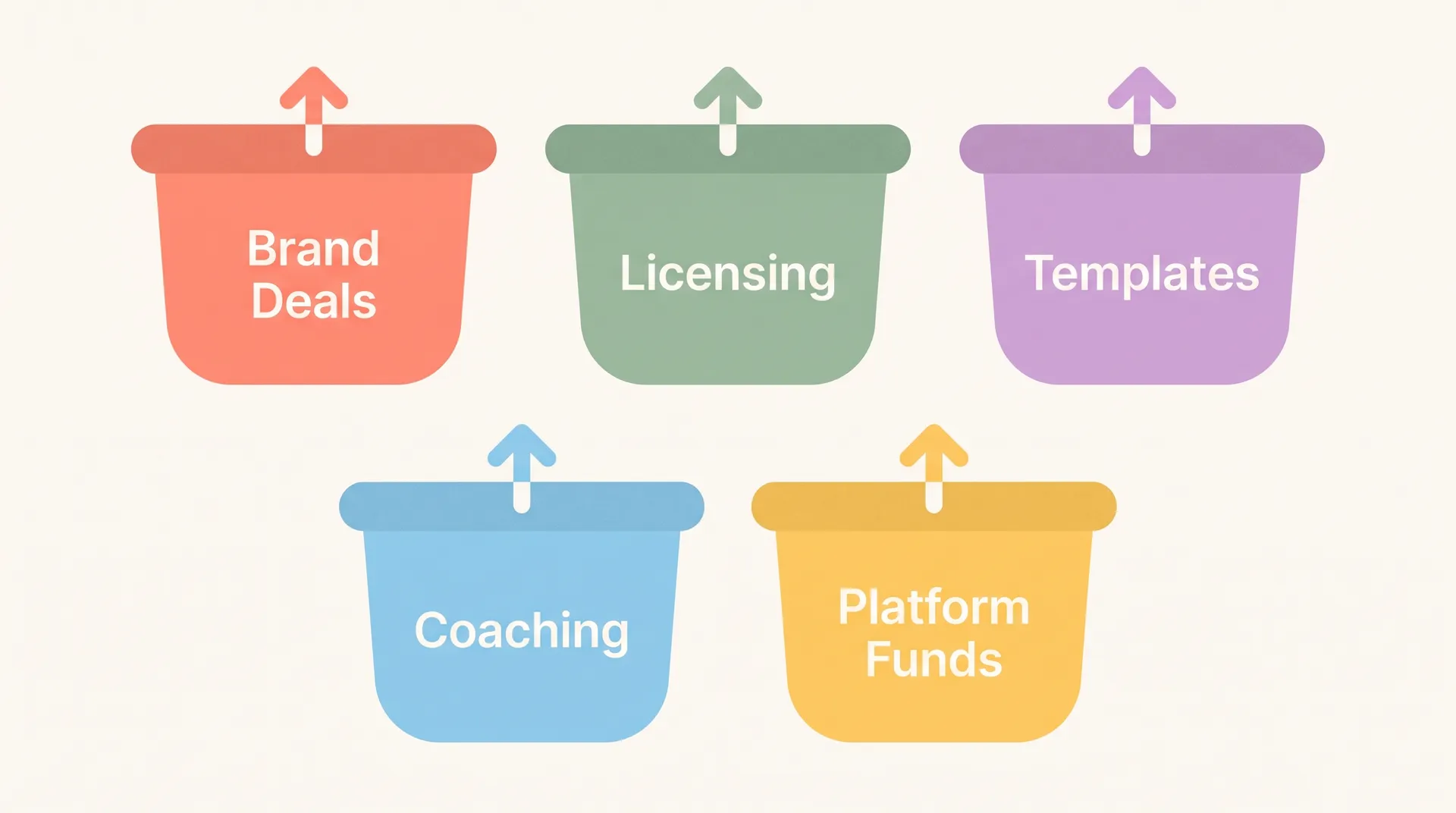
I've talked to dozens of creators through building Flare, and the ones who last aren't necessarily the most skilled videographers or the sharpest scriptwriters. They're the ones who've built ugc creator multiple revenue streams underneath the brand deal layer — so when one source dips, others hold the floor.
This post is specifically about that: the income layers beyond your core video deliverables. If you're still figuring out whether going full-time is even viable, start with how to go full-time as a UGC creator in 2025 first. But if you're already in it and you're tired of the feast-famine cycle, this is the playbook.
The UGC creator multiple revenue streams problem nobody talks about
Most advice on UGC income stops at "charge more per video" or "get a retainer." That's fine, but it doesn't solve the structural problem.
Brand deal income is inherently lumpy. A $3,000 month can be followed by an $800 month — not because you got worse, but because brands have budget cycles, approval delays, seasonal freezes, and internal chaos you'll never see. According to a 2024 Linqia creator economy survey, over 60% of content creators report significant income fluctuation month to month. That number feels right from what I've seen.
The fix isn't grinding harder for more brand deals. It's building income sources that don't all share the same risk profile.
Here's how full-time creators actually do it.
Layer 1: Usage rights and licensing fees
This one gets left on the table constantly.
When a brand buys a UGC video from you, they're paying for the creation of the asset. That's the base rate. But if they want to run it as a paid ad — on Meta, TikTok, Google — that's a separate commercial use. It requires a licensing fee on top, and most beginners don't know to charge it.
Licensing is one of the cleanest passive income streams in UGC because the work is already done. You film once, deliver the video, and then charge a recurring fee every 30, 60, or 90 days that the brand keeps running it as paid media. Rates vary, but a common structure is 15–25% of your base video rate per month of usage rights.
Some creators charge flat licensing fees — $150–$300/month per video in paid ad rotation is a reasonable middle-market number. Others tie it to ad spend. The model matters less than having one at all.
If you want to understand exactly what to charge and how to structure the language in your contracts, our guide on UGC whitelisting rights: what they are & what to charge covers the full framework. This is genuinely one of the highest-leverage pricing moves available to UGC creators, and most of them aren't doing it.
Layer 2: Retainer packages
A retainer converts a one-off brand relationship into monthly recurring revenue. That's it. That's the whole pitch.
Instead of selling 3 videos for $1,200, you offer a monthly package — say, 4 videos per month at $1,500 — with a minimum 3-month commitment. The brand wins because they get reliable, consistent creative without re-briefing a new creator every month. You win because you can actually budget your life.
The key is positioning. Don't pitch retainers to brands you've only worked with once. Do pitch them after a successful campaign, when you can say: "I know your brand voice, I know what performs, and I'd love to lock in a monthly package so you always have fresh creative ready."
Even landing two $1,500/month retainers changes everything. That's $3,000 in recurring baseline before you've opened a single cold pitch deck.
If you need a deeper breakdown of how much full-time UGC creators actually earn, the retainer component is a big part of why some creators' income looks so stable compared to others.
Layer 3: Digital products — templates, presets, and UGC bundles
This is where content monetization goes semi-passive.
Once you've been creating UGC for a few months, you have things other creators desperately want: proven script frameworks, hook structures that got approved fast, brief-reading systems, editing presets, Notion trackers for managing brand deals. That knowledge has monetary value.
A UGC script template pack selling for $27 on Gumroad doesn't sound glamorous. But if 40 people buy it in a month, that's $1,080 that required no new client work. Pair that with a deliverables tracker template at $17 and a hook swipe file at $19, and you've built a small product stack.
The creators I've seen do this well aren't running it as their main thing — they're treating it as a baseline income floor. Three to five products, $10–$47 each, marketed primarily to their existing audience on TikTok or Instagram where they're already posting about the creator process.
The content you'd naturally post anyway — "here's how I wrote this hook," "here's my filming checklist" — becomes a funnel for products that exist whether or not you're awake.
Layer 4: Coaching and consulting
This one scales with your reputation, not your time.
When you've been doing UGC for six months or more, you know things that people just starting out would pay to learn. Not because you're an expert in some abstract sense, but because you've done the actual work: pitched brands, negotiated rates, gotten revisions, handled bad briefs, built a portfolio from scratch.
One-on-one coaching sessions at $75–$150/hour are accessible to start. A four-week group coaching cohort at $300–$500/person is significantly better economics — you're serving 10 people at once instead of one.
Don't overcomplicate the positioning. "I help new UGC creators land their first three paid brand deals in 60 days" is a sharper offer than "UGC coaching." Specificity wins.
The ceiling here is genuinely high. Some established UGC coaches are pulling $5,000–$15,000/month just from group programs. That's not typical for someone in their first year, but it's a real trajectory if you build an audience alongside your creator work.
Layer 5: Platform funds and creator programs
I'll be honest: this is the weakest layer on this list.
TikTok's Creator Rewards Program, YouTube's Partner Program, and similar platform-side funds can add a few hundred dollars a month if you're posting consistently and some of your content gets organic reach. But I wouldn't build a business plan around any of them. Platform payouts change, rules shift, and the TikTok Creator Rewards Program RPM is still wildly inconsistent.
What these funds are useful for: they reward the content you're already creating. If you're posting UGC-style content to build your portfolio and attract brands, and some of it goes moderately viral, you might as well get paid for it. Treat it as a bonus, never a primary income source.
Amazon's Influencer Program is more interesting — you create short product review videos for Amazon's storefront, and you earn a commission when someone buys through your page. For creators in home, beauty, tech, or fitness niches, this can be a meaningful passive income stream that compounds over time as your video library grows.
How to prioritize which streams to build first
Don't try to build all five at once. That's how you end up half-building five things and finishing none of them.
Here's the order I'd recommend based on effort-to-return ratio:
First: Fix your licensing and usage rights pricing. This costs you zero additional work — it's just restructuring how you charge for work you're already doing. Read your contracts carefully (our contract guide is a good starting point), and make sure you're not accidentally handing over unlimited commercial rights for a flat $200 video fee.
Second: Convert at least one active brand relationship into a retainer. You already have the relationship. You just need to make the ask.
Third: Create one digital product. One. Pick the most common question new UGC creators ask you (or that you had yourself six months ago) and build a simple answer around it. A Google Doc template sold through Gumroad is a legitimate product.
Fourth: Once you have a small audience and real results to point to, think about coaching. Not before.
Fifth: Platform funds. Sign up if you qualify, post consistently, don't obsess over the payout.
If you're still in the side-hustle-to-full-time transition, this article on when to make the leap is worth reading alongside this one — because having multiple income streams is also one of the signals that tells you you're ready to go full-time.
The creators who survive long-term in UGC don't just make more money from brand deals — they make money in more ways. A $5,000 month split across three income sources is far more stable than a $5,000 month from one client who could ghost you tomorrow.
FAQ
Frequently Asked Questions
What are the best revenue streams for UGC creators beyond brand deals?
How much can UGC creators earn from licensing fees?
How do UGC creator retainer packages work?
Can UGC creators make passive income?
What digital products do UGC creators sell?
Should I build multiple revenue streams before going full-time as a UGC creator?
Related reading
- How to go full-time as a UGC creator in 2025
- UGC creator side hustle to full-time: when to leap
- How much do full-time UGC creators actually earn?
- UGC whitelisting rights: what they are & what to charge
- How to read a UGC contract before you sign
- UGC creator retainer packages: how to price monthly deals